
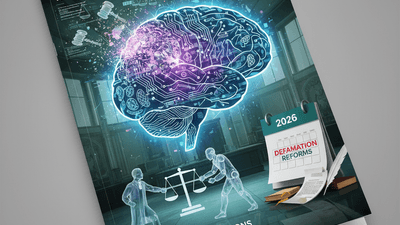



The promise of Artificial Intelligence in the legal sector has always been seductive: the ability to process vast discoveries in seconds, draft routine correspondence in moments, and democratize access to legal information. However, as the technology matures, the legal profession in Ireland and the UK is facing a stark reality check. The narrative is shifting from "adapt or die" to a more cautious "trust but verify."
Jude Copeland, a director at Cleaver Fulton Rankin, has issued a timely intervention on this precise issue. In a recent analysis for Irish Legal News, Copeland explores whether AI is a "friend or foe," highlighting the emergence of "hallucinations"—where generative AI tools confidently fabricate case law and citations that simply do not exist.
This article examines the implications of these technological pitfalls for Irish practitioners, while also rounding up significant developments in judicial review costs, insolvency precedents, and the landmark Defamation (Amendment) Act 2026.
The AI "Hallucination" Risk: A Professional Conduct Minefield
The core of Copeland's warning revolves around the misuse of public AI tools in legal research and drafting. While Large Language Models (LLMs) can mimic the style of a legal submission with uncanny accuracy, they often fail on the substance.
Two recent high-profile cases—one in the US and one closer to home in the UK—have served as cautionary tales. In these instances, legal submissions were found to contain citations to cases that were entirely entirely inventions of the AI. The software, trained to produce plausible-sounding text, simply combined real judge names with plausible-sounding case titles.
Practical Guidance for Practitioners
For Irish law firms, the integration of AI requires a bifurcation of tasks. We must distinguish between low-risk administrative tasks and high-risk substantive legal work.
| Safe AI Utilization (Green Zone) | High-Risk AI Utilization (Red Zone) |
|---|---|
| Summarizing long, verified documents provided by the user. | Asking public AI to "find case law" on a specific topic (high risk of hallucination). |
| Drafting internal emails or client updates (subject to review). | Drafting court submissions without line-by-line citation verification. |
| Ideation and brainstorming arguments. | Inputting confidential client data into public, non-secure LLMs. |
The lesson is clear: AI is a drafting assistant, not a legal researcher. As Copeland suggests, the technology is a powerful tool, but without rigorous oversight, it becomes a liability.
Access to Justice: The Battle Over Judicial Review Fees
While technology poses new challenges, old battles regarding access to justice continue to simmer. A significant conflict has erupted between the legal profession and the State regarding the Government's plan to cap fees on judicial reviews.
The Chair of the Bar Council has issued a stinging rebuke of these proposals. Reported by the Irish Examiner, the Council argues that the move constitutes an "attack on the people who use the legal system."
"There is a lack of evidence that judicial reviews are significantly delaying infrastructure projects... capping fees may simply deter legal professionals from taking on complex environmental or planning cases, effectively closing the door of the court to citizens."
This development is particularly relevant for practitioners in planning and environmental law. If the fee caps are implemented, we may see a chilling effect on the willingness of counsel to engage in judicial reviews, potentially leaving valid challenges against state decisions unheard.
Commercial Law Update: Insolvency and Arbitration
In the commercial sphere, the courts have been active in clarifying the boundaries of corporate responsibility and dispute resolution.
Precedent on Fraudulent Trading
Hayes Solicitors LLP reports on a precedent-setting disqualification period handed down in a recent fraudulent trading case. The severity of the disqualification signals that the judiciary is taking a harder line on directors who abuse the corporate veil to defraud creditors. For insolvency practitioners, this serves as a potent reminder that the consequences of fraudulent trading are becoming increasingly punitive.
Arbitration vs. Winding-Up Petitions
Furthermore, A&L Goodbody LLP highlights a significant High Court judgment clarifying the interplay between arbitration clauses and insolvency proceedings. The Court has addressed whether the existence of an arbitration clause can automatically halt a winding-up petition. This judgment provides crucial clarity for creditors seeking to enforce debts against companies that attempt to shield themselves behind arbitration agreements.
Legislative Reform: The Defamation (Amendment) Act 2026
Looking at the legislative horizon, the Defamation (Amendment) Act 2026 represents one of the most significant overhauls of Irish defamation law in decades. As outlined by Hayes Solicitors LLP, the key reforms aim to balance the right to a good name with freedom of expression more equitably.
Key aspects of the 2026 Act likely include:
- Anti-SLAPP Measures: Mechanisms to dismiss Strategic Lawsuits Against Public Participation, protecting journalists and activists from vexatious litigation.
- Serious Harm Threshold: A requirement for claimants to prove actual or likely serious harm to their reputation, reducing trivial claims.
- Abolition of Juries: The move towards judge-alone trials in defamation cases to ensure more predictable damages awards and reduce legal costs.
Practice Notes & Regulatory Warnings
Finally, several administrative and regulatory updates are essential for daily practice:
- Unauthorized Practice Warning: The Law Society has issued a warning notice regarding "Gacras Legal Services." Practitioners and the public are advised that the Society does not authorize or regulate this entity. This reinforces the theme of verification—whether dealing with AI or unknown legal entities, due diligence is paramount.
- Tailte Éireann Relocation: Property solicitors should note that the Tailte Éireann Registration Public Counter is relocating from Chancery Street to Smithfield, Dublin 7.
- Undue Influence in NI: A reminder of the courts' willingness to intervene in cases of exploitation comes from the NI High Court, which ordered a vulnerable woman duped into selling her property to pay back over £34,000 to a man who misrepresented his services.
Conclusion
From the high-tech risks of AI hallucinations to the fundamental principles of access to justice and defamation reform, the Irish legal landscape is in a state of flux. Jude Copeland's question—"AI: friend or foe?"—perhaps has a nuanced answer. AI is a friend to the efficient, but a foe to the complacent. As we move through 2026, the successful lawyer will be the one who leverages technology without surrendering their professional judgment to it.