
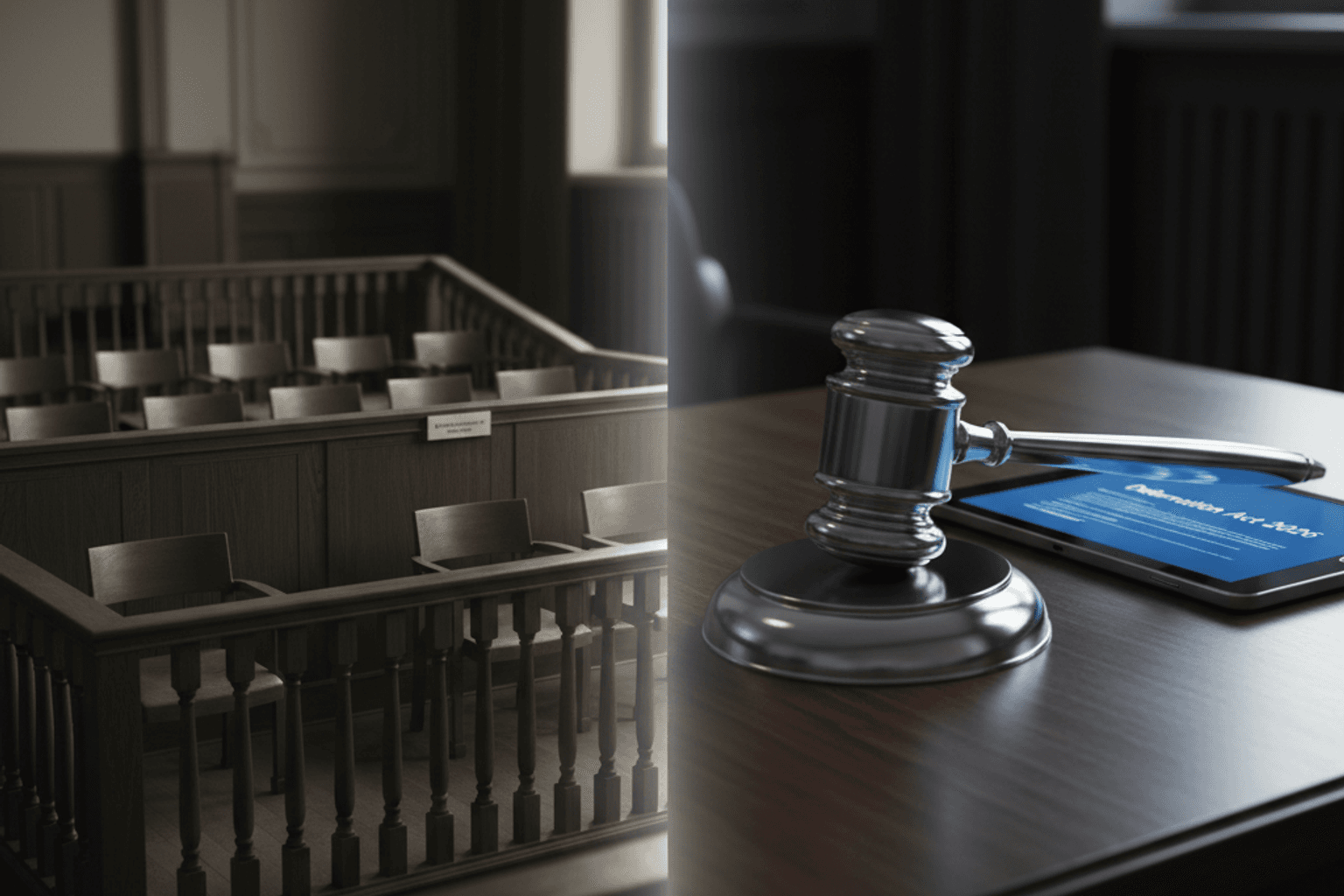



The Era of the Jury Trial is Over
For decades, the spectre of the High Court jury has loomed large over Irish defamation litigation, often driving early settlements due to the unpredictability of awards. As of today, 1 March 2026, that era has officially ended.
With the commencement of the Defamation (Amendment) Act 2026, signed into law by the President on 19 February and commenced by Minister for Justice, Home Affairs and Migration Jim O'Callaghan, the landscape of libel law in Ireland has undergone its most significant overhaul since 2009. For practitioners, this is not merely a legislative update; it is a fundamental shift in litigation strategy. The removal of juries, combined with the new 'serious harm' threshold for corporate bodies, requires an immediate pivot in how we advise clients and plead cases.
The "What": Key Provisions in Force Today
According to the Law Society of Ireland and recent commencement orders, the following provisions are now operative:
- Abolition of Juries: High Court defamation cases will now be heard by a judge alone. This is intended to reduce legal costs, shorten hearing times, and ensure more consistent damages awards.
- 'Serious Harm' Test: Bodies corporate can no longer sue for defamation unless they can demonstrate that the statement has caused, or is likely to cause, serious financial loss.
- Retail Defamation Defence: A new statutory defence is available for 'transient retail defamation' (e.g., a shopkeeper asking a customer for a receipt), provided the inquiry is made in good faith and not disproportionately.
- Circuit Court Jurisdiction: The Circuit Court now has the statutory power to grant 'Norwich Pharmacal' type orders to identify anonymous online posters, significantly reducing the cost of such applications.
- Public Interest Defence: A simplified and clarified defence of fair publication on a matter of public interest.
Note: Part 7 of the Act, concerning Anti-SLAPP (Strategic Lawsuits Against Public Participation) measures, has been signaled for commencement at a later date to align with the forthcoming Strategic Lawsuits Against Public Participation Bill.
The "So What": Impact on Legal Workflows
The immediate implication for solicitors is the removal of the "jury factor" from settlement negotiations. Previously, the risk of a sympathetic jury awarding disproportionate damages was a key lever for plaintiffs. Now, with a judge-alone system, we can expect more predictable, precedent-based awards. This likely shifts the focus from emotional advocacy to technical legal argumentation regarding the 'serious harm' threshold and the new statutory defences.
For corporate clients, the bar has been raised significantly. The requirement to prove "serious financial loss" mirrors the UK's approach and will likely filter out minor reputational slights. Solicitors must now demand concrete evidence of financial impact—such as a drop in share price or loss of specific contracts—before issuing proceedings on behalf of a company.
Conversely, the Circuit Court's new power to unmask anonymous trolls democratises access to justice. Previously, seeking a Norwich Pharmacal order in the High Court was prohibitively expensive for many individuals. This change opens a new, cost-effective avenue for clients suffering from online harassment.
The "Now What": Action Plan for Solicitors
To remain compliant and effective under the new regime, practitioners should take the following steps immediately:
- Review Active Files: Assess all pending defamation instructions. For corporate plaintiffs, verify if the evidence meets the new 'serious harm' and 'serious financial loss' standards.
- Update Retail Client Advice: Advise retail clients to update their staff training manuals. Security staff must understand the specific parameters of the new 'retail defamation' defence—specifically, that inquiries must be made "in good faith" and not in a manner that attracts disproportionate attention.
- Revise Litigation Strategy: Move away from jury-centric pleading strategies. Focus submissions on the technical application of the new public interest defence and the specific statutory criteria for damages.
- Prepare for Circuit Court Applications: Familiarise yourself with the new rules for seeking identification orders in the Circuit Court. This will likely become a high-volume area of practice for private client teams.
Mastering the New Landscape
The abolition of juries is just the beginning. As the Anti-SLAPP provisions loom on the horizon, the procedural complexity of defamation law is set to increase further. To help you navigate these changes, the Law Society is hosting upcoming CPD training sessions focused on litigating without juries and navigating the new statutory defences. These sessions will provide the essential tools to master these procedural shifts and ensure your practice is ready for the new reality.